
How GRC Software Improves Business Resilience and Decision-Making
July 27, 2026
Rajiv


Today's business environment is more complex than ever. Organizations face increasing regulatory requirements, cybersecurity threats, third-party risks, operational disruptions, economic uncertainty, and evolving customer expectations. Businesses that rely on spreadsheets, disconnected systems, or manual compliance processes often struggle to identify risks before they become costly problems.
This is where Governance, Risk, and Compliance (GRC) software has become an essential business tool rather than a luxury.
Modern GRC platforms enable organizations to centralize compliance activities, monitor enterprise risks, automate workflows, and provide leadership with accurate, real-time information for better strategic decisions. Instead of reacting to issues after they occur, businesses can proactively identify, assess, and mitigate risks while improving operational efficiency.
In this guide, we'll explore how GRC software strengthens business resilience, enhances executive decision-making, and helps organizations remain compliant in an increasingly uncertain world.
What Is GRC Software?
Governance, Risk, and Compliance (GRC) software is a centralized platform that helps organizations manage:
- Corporate governance
- Enterprise risk management
- Regulatory compliance
- Internal controls
- Audit management
- Third-party risk
- Policy management
- Incident tracking
- Business continuity planning
Rather than operating these functions separately, GRC software connects them into one integrated system, giving executives and compliance teams a complete view of organizational risk.

Why Business Resilience Matters More Than Ever
Business resilience is the ability of an organization to prepare for, respond to, and recover from disruptions while maintaining operations.
Today's organizations must prepare for events such as:
- Cybersecurity attacks
- Data breaches
- Regulatory changes
- Vendor failures
- Economic downturns
- Natural disasters
- Supply chain disruptions
- Operational failures
- Fraud
- Human error
Resilient organizations don't eliminate every risk—they identify risks early and respond quickly.
This is exactly where GRC software delivers value.
1. Centralized Risk Visibility
One of the biggest challenges organizations face is fragmented information.
Risk data often lives across:
- Excel spreadsheets
- Email conversations
- Individual departments
- Shared drives
- Separate compliance tools
Without centralized visibility, leadership cannot accurately understand the organization's overall risk exposure.
A modern GRC platform consolidates all risk information into a single dashboard, enabling stakeholders to:
- View enterprise risks
- Monitor compliance status
- Track remediation activities
- Prioritize critical issues
- Identify emerging threats
With a complete view of organizational risk, decision-makers can respond faster and with greater confidence.
2. Better Executive Decision-Making
Business leaders make hundreds of strategic decisions each year.
These decisions may involve:
- Entering new markets
- Launching products
- Partnering with vendors
- Investing in technology
- Acquiring companies
- Expanding internationally
Poor-quality or incomplete data often leads to poor decisions.
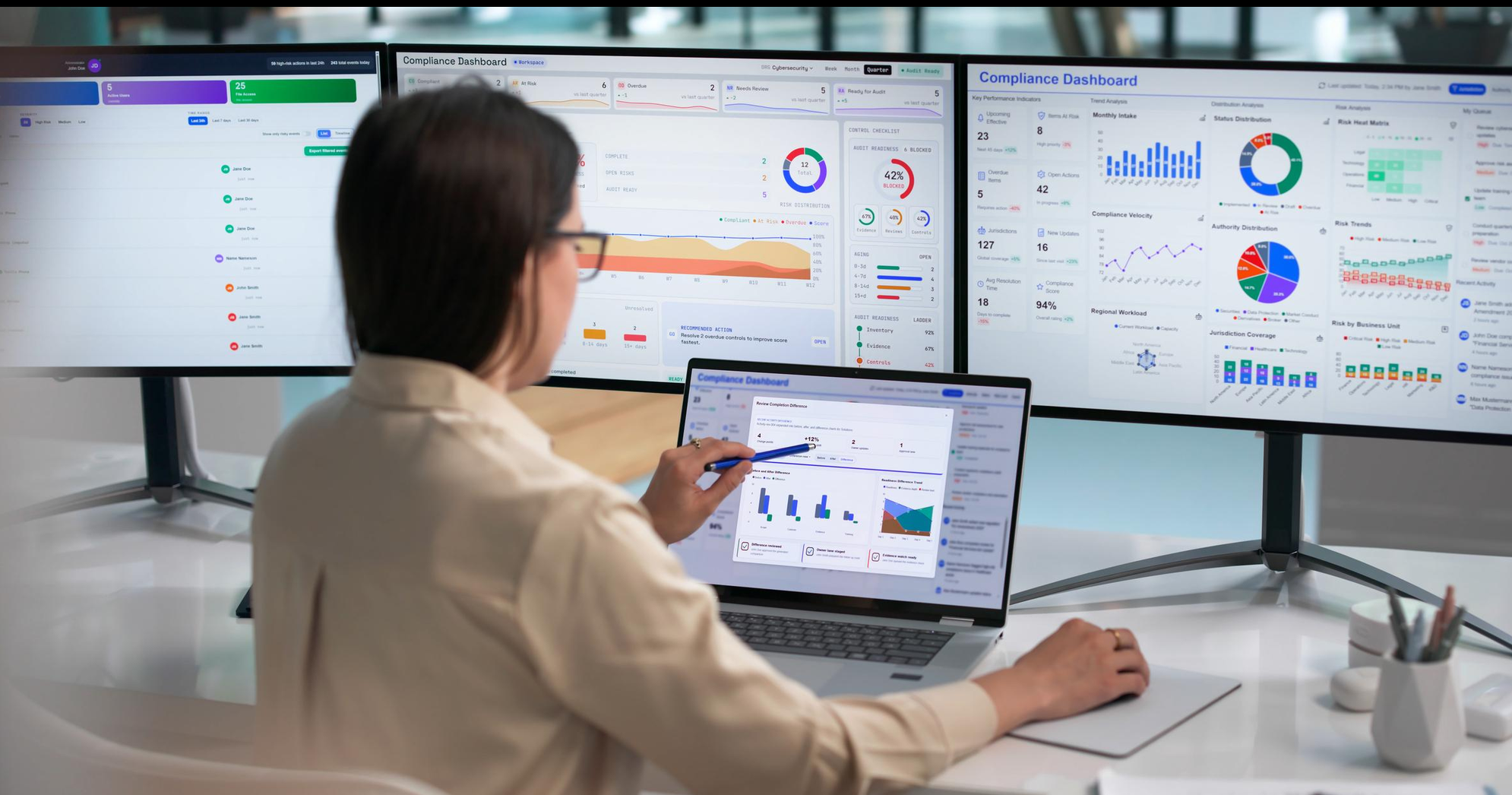
GRC software provides executives with real-time dashboards, reports, and analytics that support informed decision-making.
Executives can instantly evaluate:
- Compliance performance
- Operational risks
- Financial exposure
- Vendor risks
- Cybersecurity posture
- Regulatory obligations
- Audit findings
Instead of relying on assumptions, leaders make decisions based on measurable business intelligence.
3. Improved Regulatory Compliance
Compliance requirements continue to grow across nearly every industry.
Organizations must comply with regulations such as:
- GDPR
- HIPAA
- SOX
- PCI DSS
- ISO 27001
- SOC 2
- AML requirements
- Banking regulations
- Financial reporting standards
Manual compliance management often results in:
- Missed deadlines
- Inconsistent documentation
- Human error
- Regulatory penalties
GRC software automates compliance activities by:
- Tracking regulatory changes
- Scheduling compliance reviews
- Managing evidence collection
- Monitoring control effectiveness
- Generating audit-ready reports
- Maintaining compliance documentation
Automation significantly reduces compliance risks while saving valuable time.
4. Faster Risk Identification
Organizations cannot manage risks they cannot see.
Traditional annual risk assessments often fail to detect rapidly changing threats.
Modern GRC platforms support continuous risk monitoring by:
- Tracking key risk indicators (KRIs)
- Monitoring operational metrics
- Identifying unusual patterns
- Alerting teams to emerging risks
- Updating risk scores automatically
Continuous monitoring allows organizations to address risks before they become major incidents.
5. Stronger Third-Party Risk Management
Most organizations rely on vendors, suppliers, cloud providers, and outsourcing partners.
Every third-party relationship introduces additional risk.
Potential issues include:
- Data breaches
- Financial instability
- Compliance violations
- Service interruptions
- Cybersecurity vulnerabilities
GRC software simplifies vendor risk management through:
- Vendor onboarding workflows
- Due diligence questionnaires
- Risk scoring
- Compliance assessments
- Document management
- Continuous monitoring
Organizations gain greater confidence when selecting and managing external partners.
6. Improved Business Continuity
Unexpected disruptions can significantly impact operations.
Examples include:
- Ransomware attacks
- IT outages
- Natural disasters
- Vendor failures
- Regulatory investigations
Business continuity planning becomes much more effective with GRC software.
Organizations can:
- Maintain recovery plans
- Track critical assets
- Assign responsibilities
- Test recovery procedures
- Monitor response activities
- Improve disaster preparedness
Prepared organizations recover faster while minimizing operational disruption.
7. Increased Operational Efficiency
Manual compliance processes consume significant employee time.
Tasks like:
- Policy reviews
- Audit preparation
- Risk assessments
- Control testing
- Evidence collection
- Reporting
can require hundreds of hours each year.
Automation reduces repetitive administrative work.
Employees spend less time managing spreadsheets and more time focusing on strategic initiatives that create business value.
8. Better Collaboration Across Departments
Risk management isn't just the responsibility of compliance teams.
Departments including:
- IT
- Finance
- HR
- Operations
- Procurement
- Legal
- Internal Audit
all contribute to organizational resilience.
A centralized GRC platform enables every department to collaborate through shared workflows, standardized processes, and real-time visibility.
Improved communication leads to faster issue resolution and stronger governance.
9. Data-Driven Risk Prioritization
Not every risk deserves the same level of attention.
GRC software helps organizations prioritize risks based on:
- Likelihood
- Business impact
- Financial exposure
- Regulatory consequences
- Operational disruption
Instead of reacting to every issue equally, leadership can focus resources where they matter most.
10. Enhanced Audit Readiness
Audits often create unnecessary stress because documentation is scattered across multiple systems.
GRC software centralizes:
- Policies
- Procedures
- Control evidence
- Risk registers
- Audit history
- Corrective actions
Auditors gain access to organized, accurate information, reducing audit preparation time and improving audit outcomes.
11. Real-Time Reporting and Analytics
Modern executives need instant access to business information.
GRC dashboards provide insights into:
- Compliance status
- Risk heat maps
- Control effectiveness
- Vendor performance
- Incident trends
- Audit progress
- Outstanding issues
Interactive reporting improves transparency throughout the organization.
12. AI and Automation Enhance GRC
Artificial intelligence is transforming modern GRC platforms.
AI capabilities now include:
- Intelligent risk detection
- Predictive analytics
- Automated document review
- Policy recommendations
- Regulatory monitoring
- Workflow automation
AI enables organizations to identify risks earlier while reducing manual effort.
Key Features to Look for in Modern GRC Software
When evaluating a GRC platform, organizations should prioritize features such as:
- Enterprise Risk Management
- Compliance Management
- Vendor Risk Management
- Internal Audit Management
- Policy Management
- Workflow Automation
- Evidence Collection
- Regulatory Change Tracking
- AI-Powered Analytics
- Executive Dashboards
- Third-Party Due Diligence
- Business Continuity Planning
- Document Management
- Role-Based Access Controls
- Custom Reporting
A scalable platform should grow alongside your organization's evolving risk and compliance needs.
Industries That Benefit Most from GRC Software
Although GRC software supports organizations across many sectors, it delivers exceptional value for:
- Financial Services
- Banking
- FinTech
- Insurance
- Healthcare
- Manufacturing
- Energy
- Government
- Technology Companies
- Enterprise SaaS Providers
Any organization operating in a regulated environment can benefit from integrated governance, risk, and compliance management.
The Future of Business Resilience
The future belongs to organizations that can adapt quickly to change.
Business resilience is no longer just about disaster recovery. It requires continuous visibility, proactive risk management, regulatory compliance, and data-driven decision-making.
Organizations that embrace modern GRC software gain a competitive advantage by improving operational efficiency, strengthening governance, reducing compliance risks, and making smarter strategic decisions.
As regulations become more complex and business risks continue to evolve, investing in the right GRC platform is one of the most effective ways to protect long-term business success.
Frequently Asked Questions (FAQs)
What is GRC software?
GRC software is a platform that helps organizations manage governance, enterprise risk, regulatory compliance, audits, and internal controls from a centralized system.
How does GRC software improve business resilience?
It enables organizations to identify risks early, automate compliance, improve business continuity planning, strengthen vendor oversight, and support faster responses to disruptions.
Who should use GRC software?
Organizations of all sizes can benefit, especially those in banking, financial services, healthcare, technology, insurance, manufacturing, and other regulated industries.
Can GRC software improve executive decision-making?
Yes. GRC platforms provide real-time dashboards, analytics, and risk insights that help leadership make informed strategic decisions based on accurate, organization-wide data.
What are the biggest benefits of GRC software?
Key benefits include:
- Improved compliance
- Better risk visibility
- Faster audits
- Automated workflows
- Enhanced collaboration
- Stronger third-party risk management
- Better operational resilience
- More informed business decisions
Register for a Themis Demo
Business resilience begins with better visibility, smarter risk management, and streamlined compliance. Themis helps organizations centralize Governance, Risk, and Compliance activities, automate workflows, strengthen third-party due diligence, and empower leaders with real-time insights for confident decision-making.
Ready to build a more resilient organization?
👉 Register for a Themis Demo to see how Themis can simplify compliance, improve risk management, and support sustainable business growth.


