
Why Scattered Business Documents Create Risk—and How to Fix It
October 7, 2026
Neepa


Business documents are more than files stored in folders. Legal agreements define obligations, financial records support important decisions, pricing sheets guide commercial activity, and compliance documents help demonstrate that an organization is meeting its responsibilities.
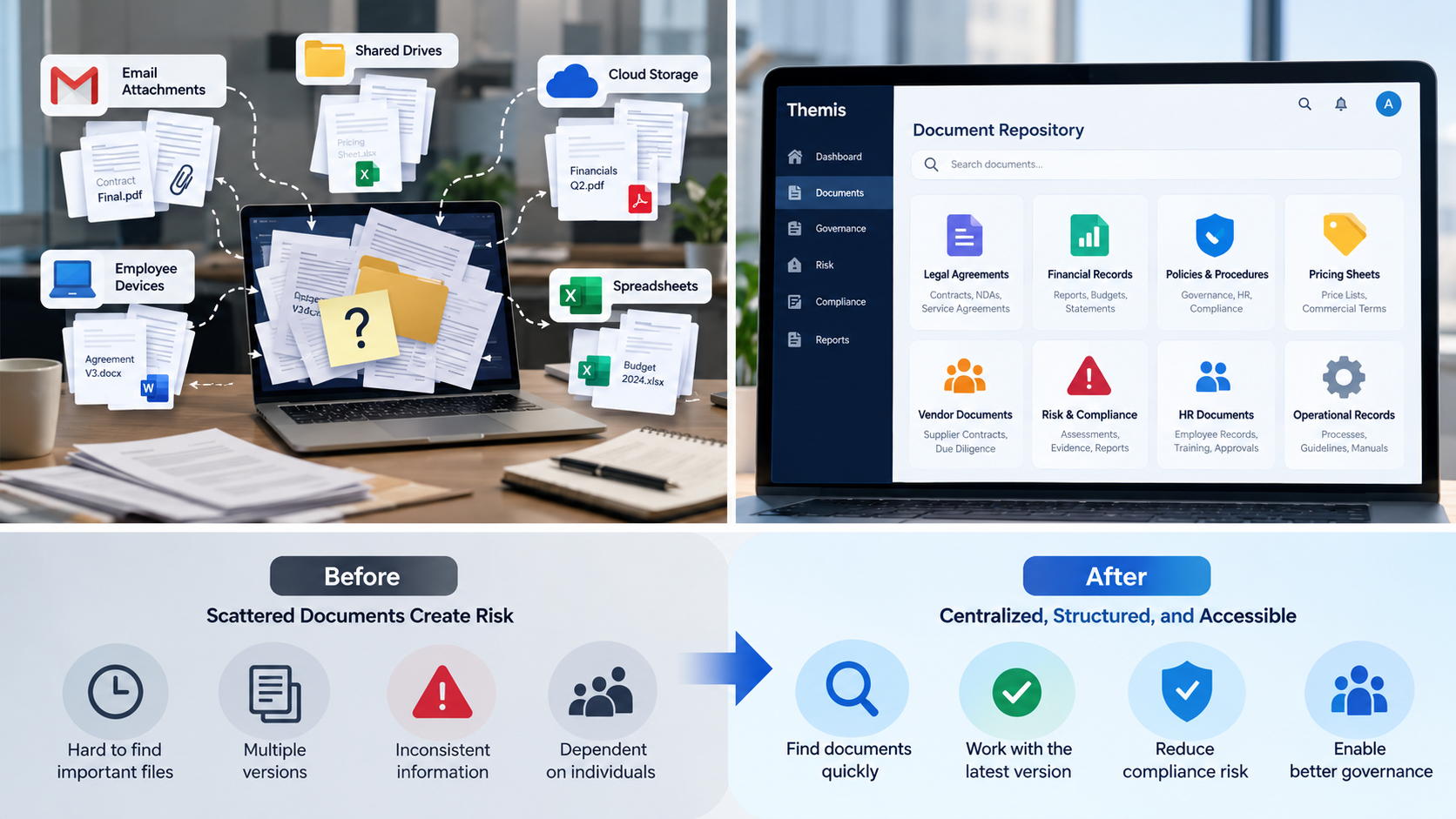
Yet as organizations grow, these critical files often become scattered across shared drives, email inboxes, employee computers, cloud storage platforms, spreadsheets, and departmental folders.
At first, this may seem like an inconvenience rather than a serious business problem. But fragmented document storage can quickly create operational, compliance, financial, and governance risks.
When employees cannot easily determine where an important document is stored, whether they are looking at the latest version, or who is responsible for maintaining it, decision-making becomes harder. Audits can become more stressful, outdated information can remain in circulation, and important records may be overlooked.
A more structured approach to document management can help organizations establish a reliable source of information and maintain a clearer record of critical business files.
Why Do Scattered Business Documents Create Risk?
Scattered documents create risk because they make it difficult to know whether the information being used is complete, current, accurate, and properly controlled.
Imagine that a company has supplier agreements in one shared drive, pricing sheets in another system, financial documents in spreadsheets, and policy records attached to emails.
An employee preparing for a review may need to search multiple locations just to gather the necessary information. Even after finding the documents, another question remains:
Are these the correct and most current versions?
This uncertainty can create unnecessary risk.
Organizations need more than document storage. They need a structured way to organize, maintain, retrieve, and understand the records that support important business activities.
1. Important Documents Become Difficult to Find
One of the most immediate problems with fragmented document management is poor accessibility.
Employees can waste valuable time searching through folders, emails, cloud drives, and internal systems for information that should be readily available.
Which one is correct?
Without consistent organization, employees may spend unnecessary time confirming information or asking colleagues for assistance.
A centralized and clearly structured document repository can make it easier for authorized users to locate the information they need.
2. Multiple Versions Can Create Confusion
Version confusion is one of the most common consequences of scattered document storage.
Consider a pricing sheet that has been updated several times. Sales has one copy, finance has another, and a manager has the newest version saved locally.
An employee could accidentally send an outdated pricing sheet to a customer simply because there is no obvious way to identify the current approved version.
The same problem can occur with:
- Legal agreements
- Policies and procedures
- Financial reports
- Risk assessments
- Vendor documents
- Compliance records
- Pricing information
- Internal approvals
When important documents are distributed across different locations, maintaining a clear record becomes much more difficult.
Better document organization helps establish greater confidence that teams are working from the right information.
3. Scattered Records Make Audits More Difficult
When an auditor or internal reviewer requests documentation, the organization needs to locate relevant records efficiently.
If documents are scattered across systems, gathering evidence may involve multiple employees and departments.
Teams may have to search for contracts, approvals, financial information, policies, risk documentation, or other records before they can respond to a request.
This can make an audit more resource-intensive than necessary.
Good document management supports audit readiness by helping organizations maintain important records in an organized and accessible environment.
Instead of beginning the search only after a request arrives, teams can maintain records continuously as part of normal business operations.
4. Critical Business Knowledge Can Become Dependent on Individuals
Another hidden risk of fragmented document storage is dependence on specific employees.
For example:
“Ask Sarah. She knows where the supplier contracts are.”
Or:
“John has the latest pricing spreadsheet.”
This may work temporarily, but it is not a reliable document management strategy.
What happens when that employee changes roles, goes on leave, or leaves the company?
Important organizational knowledge should not depend entirely on one person's inbox, computer, or memory.
A centralized approach can help transform individually held knowledge into accessible organizational information.
5. Legal Agreements Can Be Harder to Manage
Legal agreements may contain important obligations, renewal terms, responsibilities, pricing conditions, and other business requirements.
When agreements are stored inconsistently, teams may find it more difficult to maintain a complete view of their legal records.
For example, different departments might retain separate copies of:
- Vendor agreements
- Client contracts
- Service agreements
- Partnership agreements
- Confidentiality agreements
- Licensing documents
Centralizing these documents can make it easier to maintain a clear record of important agreements and provide authorized stakeholders with access when required.
6. Financial and Pricing Information Can Become Inconsistent
Financial records and pricing information often change over time.
If older files remain in circulation, teams can unintentionally rely on outdated data.
For example, a sales employee may use an old pricing sheet, while finance has already approved updated pricing.
This is more than an administrative inconvenience. Inconsistent information can affect customer communication, internal reporting, budgeting, and business decisions.
Organizing important financial and commercial documents within a structured system can reduce confusion and improve information consistency.
7. Poor Document Organization Can Increase Compliance Risk
Governance, risk, and compliance activities depend heavily on reliable information.
Organizations may need documentation to demonstrate that processes were followed, decisions were approved, policies were maintained, or required controls were implemented.
When supporting documentation is fragmented, providing that evidence becomes harder.
A strong GRC environment therefore requires more than creating policies and conducting assessments. Organizations also need to maintain the documents that support those activities.
Centralized document management can help connect business records with broader governance, risk, and compliance processes.
How Can Businesses Fix Scattered Document Management?
Moving every file into a single folder is not enough. Effective document organization requires structure, ownership, consistency, and clear processes.
Here are several practical steps organizations can take.
Create a Centralized Document Repository
Establish a central location for important business documents.
Rather than storing critical records across employee computers, inboxes, and disconnected folders, organizations should create a structured repository where authorized employees know where to find key information.
Documents might be categorized according to areas such as:
- Legal
- Finance
- Compliance
- Risk
- Vendors
- Policies
- Pricing
- Operations
The exact structure will depend on the organization, but consistency is essential.
Establish Clear Document Ownership
Every important category of documentation should have appropriate ownership.
Someone should understand who is responsible for maintaining relevant records and ensuring that information remains current.
Document ownership helps answer important questions:
Who maintains this document?
Who approves changes?
Who should update it?
Who should have access?
Clear accountability can significantly improve document governance.
Standardize Naming and Organization
Consistent naming conventions make documents easier to search, understand, and manage.
Instead of vague filenames such as:
Contract-New-Final2.pdf
organizations can use a standardized format that includes meaningful details such as document type, company or vendor, and relevant date or version information.
Consistency becomes particularly valuable as the volume of documentation grows.
Maintain a Clear Record of Key Files
Organizations should be able to understand which important documents they maintain and where those records belong.
Legal agreements, financials, pricing sheets, policies, and other critical files should not disappear into forgotten folders.
Maintaining a structured record helps improve visibility and makes important information easier to retrieve when needed.
Control Access Appropriately
Centralization does not mean every employee should have access to every document.
Some records may contain confidential, legal, financial, or commercially sensitive information.
Organizations should consider appropriate access controls so that authorized individuals can obtain the information required for their responsibilities while sensitive documents remain protected.
Review Documents Regularly
Document management should be treated as an ongoing process rather than a one-time cleanup project.
Organizations should periodically review important records to identify outdated, duplicate, incomplete, or unnecessary files.
Regular reviews can help maintain a cleaner and more dependable document environment.
From Document Storage to Better Governance
The ultimate goal is not simply to create a tidier digital filing cabinet.
Better document management supports better governance.
When important business records are organized, teams can find information faster, understand responsibilities more clearly, and maintain stronger evidence for risk and compliance activities.
A centralized approach can also help organizations create a more reliable source of truth.
Instead of asking:
“Where is the latest file?”
teams can focus on more valuable questions:
“What does this information tell us, and what action should we take?”
That shift can improve both operational efficiency and organizational oversight.
FAQ: Business Document Management
What is centralized document management?
Centralized document management is an approach in which important business files are organized within a structured, accessible repository rather than being distributed across unrelated locations. It can help employees locate records more efficiently and maintain greater consistency.
What types of business documents should be organized centrally?
Organizations may centralize documents such as legal agreements, financial records, pricing sheets, policies and procedures, vendor documents, compliance evidence, risk documentation, and other important operational records.
Why are scattered documents a compliance risk?
Scattered documentation can make it more difficult to locate evidence, confirm the latest version of a file, establish ownership, and respond efficiently to internal or external reviews.
How does document management help with audits?
Well-organized documentation can make it easier to retrieve requested records and supporting evidence. This can reduce the amount of time teams spend searching for documents during an audit or review.
How can companies prevent employees from using outdated documents?
Organizations can establish a centralized repository, clear ownership, standardized naming and version practices, appropriate access controls, and regular document reviews.
Can document management support GRC programs?
Yes. Governance, risk, and compliance activities frequently depend on policies, agreements, assessments, approvals, financial records, and supporting evidence. Organizing these documents can provide stronger visibility and support more structured GRC processes.
Build a Clearer Record of Critical Business Information
Scattered documents may appear to be a simple administrative problem, but the consequences can extend into operations, compliance, governance, financial management, and decision-making.
As organizations grow, relying on disconnected folders, email attachments, local files, and employee memory becomes increasingly difficult.
The solution is to establish a more structured approach.
By centralizing important records, defining ownership, improving consistency, controlling access, and regularly reviewing documentation, businesses can create a more dependable information environment.
Try Themis Today
The Total Solution for Governance, Risk, and Compliance
With Themis, organizations can organize documents efficiently and maintain a clear record of key files like legal agreements, financials, and pricing sheets.
Bring critical business information into a more organized GRC environment and give your teams greater visibility into the records that matter.
Try Themis today and take a more structured approach to governance, risk, compliance, and critical business documentation.


